

Pumpkin Seed Extract (Cucurbita pepo): Prostate, Urinary and Hair Research, and Safety
Quick answer: Pumpkin seed (Cucurbita pepo) has been used for generations in Central Europe to support men's bladder and prostate comfort. Its seeds are rich in plant sterols, tocopherols, fatty acids and minerals such as zinc and magnesium. In the largest trial, the one-year GRANU study of 1,431 men, whole pumpkin seed eased urinary symptoms somewhat more than placebo, while a pumpkin seed extract did not. A small 24-week trial found a pumpkin seed oil supplement increased hair counts in men with male-pattern hair loss. Zenmen uses 200 mg of pumpkin seed extract in both 10-in-1 Prostate Support and Hair Growth & Root Defense.*
Key takeaways
- In the GRANU trial, 58.5% of men eating 10 g of pumpkin seed a day responded, versus 47.3% on placebo; the extract arm did not differ from placebo. [1]
- Smaller open studies of pumpkin seed extracts report lower symptom scores and less night-time urination, but had no placebo group. [2] [3]
- A 24-month study found no negative effect on sexual function. [3]
- In a 76-man trial, 400 mg a day of a pumpkin seed oil supplement increased hair counts by 40% vs 10% with placebo over 24 weeks. [4]
- Pumpkin seed is a food and is very well tolerated in studies.
What Is Pumpkin Seed?
Pumpkin seeds come from Cucurbita pepo, the same species as many squashes and the Styrian oil pumpkin of Austria, whose hull-less seeds are pressed for dark green pumpkin seed oil. In Germany and Austria, pumpkin seed preparations are a traditional choice for an irritable bladder and for urinary complaints as the prostate enlarges with age. The seeds contain delta-7 phytosterols, lignans, tocopherols (vitamin E), unsaturated fatty acids, protein and minerals including zinc and magnesium.
Seed, Oil or Extract?
- Whole seed: a food; studies use about 10 g a day. [1]
- Seed oil: concentrates the fat-soluble compounds such as sterols and tocopherols; used in the hair trial. [4]
- Extract: concentrated preparations, including oil-free water-alcohol extracts and soft extracts, that fit into a capsule. [2]
Results from one form do not automatically apply to another, so we report each study with the form it used.
What the Research Shows
Urinary comfort in men
The GRANU study, run at a German urology department, followed 1,431 men aged 50 to 80 with urinary symptoms for 12 months. They took 5 g of pumpkin seed twice a day, 500 mg of pumpkin seed extract twice a day, or placebo. The response rate for the extract did not differ from placebo. For whole pumpkin seed, 58.5% responded versus 47.3% on placebo, a difference the authors called descriptive and in need of confirmation. [1]
In a 2019 pilot study of 60 men, an oil-free pumpkin seed extract taken at bedtime for 12 weeks lowered the average symptom score by about 30% and reduced night-time urination, but there was no placebo group and several authors worked for companies involved with the extract. [2] A 24-month observational study of a pumpkin seed soft extract in 130 men reported a 4.7-point average drop in symptom score at 12 months and no negative effect on sexual function; some authors worked for the product's manufacturer. [3]
Hair
In a 2014 double-blind trial in Korea, 76 men with mild to moderate male-pattern hair loss took 400 mg a day of a pumpkin seed oil supplement or placebo for 24 weeks. Hair counts rose by an average of 40% with pumpkin seed oil versus 10% with placebo, self-rated improvement was higher, and side effects did not differ between groups. [4] It was a single, small, industry-funded study of an oil-based product, so larger trials are needed.
How Pumpkin Seed May Support the Body*
- Supports normal prostate and bladder function.*
- Supports healthy urinary flow and comfortable daily urinary habits.*
- Supports healthy hair density and scalp health as part of a complete formula.*
Pumpkin Seed in Zenmen Products
| Product | Form | Amount per serving |
|---|---|---|
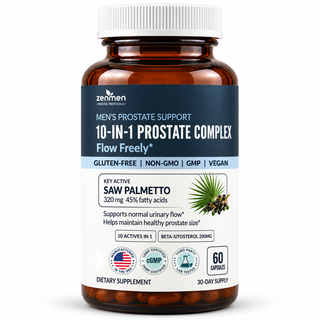
| 10-in-1 Prostate Support | Seed extract | 200 mg per 2 capsules |
| Hair Growth & Root Defense | Seed extract | 200 mg |
In both formulas, pumpkin seed works alongside 320 mg of saw palmetto and stinging nettle root. 10-in-1 Prostate Support adds beta-sitosterol, pygeum and lycopene, while Hair Growth & Root Defense adds biotin, zinc and other hair nutrients. The amount per serving is a supporting dose, smaller than in the trials above. The two products overlap, so check with your clinician before taking both.
How to Take It
- 10-in-1 Prostate Support: 2 capsules daily with water, ideally with a meal.
- Hair Growth & Root Defense: follow the serving on the label.
- Give it time: the studies above ran for 3 to 12 months.
- Raw or roasted pumpkin seeds (pepitas) are also a nutritious everyday food.
Safety
- Well tolerated: pumpkin seed and its extracts were well tolerated in the trials above, and side effects in the hair trial did not differ from placebo. [1] [4]
- Allergy: avoid if you are allergic to pumpkin or other seeds.
- See a doctor first: new or worsening urinary symptoms, blood in the urine or sudden hair loss should be checked by a doctor.
- Medications: ask your pharmacist if you take prescription prostate, hormone or hair-loss medicines such as finasteride or dutasteride.
FAQ
Is pumpkin seed good for the prostate?
Pumpkin seed is a traditional choice for prostate and bladder comfort.* In a one-year trial, whole seed helped somewhat more than placebo, but the extract tested did not. [1]
Does pumpkin seed oil help hair growth?
One small 24-week trial found higher hair counts with 400 mg a day of a pumpkin seed oil supplement than with placebo. Larger studies are needed. [4]
Does pumpkin seed affect sexual function?
A 24-month study of a pumpkin seed extract found no negative effect on sexual function. [3]
Conclusion
Pumpkin seed is a gentle, food-based botanical with a long tradition for men's urinary comfort, mixed but encouraging human research, and an early hair study. Zenmen includes 200 mg of pumpkin seed extract in 10-in-1 Prostate Support and Hair Growth & Root Defense to complement saw palmetto and nettle root.* See your doctor about any new urinary symptoms or hair loss.
References
- Vahlensieck, W., Theurer, C., Pfitzer, E., Patz, B., Banik, N., & Engelmann, U. (2015). Effects of pumpkin seed in men with lower urinary tract symptoms due to benign prostatic hyperplasia in the one-year, randomized, placebo-controlled GRANU study. Urologia Internationalis, 94(3), 286–295. https://doi.org/10.1159/000362903
- Leibbrand, M., Siefer, S., Schön, C., et al. (2019). Effects of an Oil-Free Hydroethanolic Pumpkin Seed Extract on Symptom Frequency and Severity in Men with Benign Prostatic Hyperplasia: A Pilot Study in Humans. Journal of Medicinal Food, 22(6), 551–559. https://doi.org/10.1089/jmf.2018.0106
- Theil, G., Richter, M., Schulze, M., et al. (2022). Extract from Cucurbita pepo improves BPH symptoms without affecting sexual function: a 24-month noninterventional study. World Journal of Urology, 40(7), 1769–1775. https://doi.org/10.1007/s00345-022-04036-w
- Cho, Y. H., Lee, S. Y., Jeong, D. W., et al. (2014). Effect of Pumpkin Seed Oil on Hair Growth in Men with Androgenetic Alopecia: A Randomized, Double-Blind, Placebo-Controlled Trial. Evidence-Based Complementary and Alternative Medicine, 2014, 549721. https://doi.org/10.1155/2014/549721
*These statements have not been evaluated by the Food and Drug Administration. This product is not intended to diagnose, treat, cure or prevent any disease. Consult your healthcare provider before use, especially if you are pregnant, nursing, taking medication or have a medical condition.